
Two Key Parts of Effective CommunicationTwo Key Parts of Effective CommunicationTwo Key Parts of Effective CommunicationTwo Key Parts of Effective Communication
Donate
  • Stories
  • myCISV
  • eLearn
  • Home
  • About Us
    • What We Do
    • News and blogs
    • Our Story
    • Governance
    • Our Partners
    • Diversity, Equity and Inclusion
    • Publications
    • Jobs and Internships
    • International Office Staff
    • Open Calls for Proposals
  • Programmes
    • Village
      Our flagship camp
      Age 11 // 28 days
    • Youth Meeting
      Smaller regional camps
      Age 12-13 // 8 or 15 days
    • Step Up
      Camps planned and run with participants
      Age 14-15 // 23 days
    • Seminar Camp
      Camps planned by staff and participants
      Age 16-17 // 21 days
    • Interchange
      2-way family exchanges
      Age 14-15 // 14-28 days
    • National Programmes
    • Mosaic
      Local community-based programme for participants of all ages
      Anything from a one-off event to a year-long project
    • Your Child and CISV
  • Our World
  • Support Us
    • Donate
    • Partner With Us
  • Volunteer
  • Resources
    • Document Search
    • Programme Resources
    • Educational Content & Research
    • Risk Management & Safeguarding
    • NA and Chapter Support
    • CISV International
    • Profile Raising & Fundraising
    • Training
    • Volunteer
    • Junior Branch
    • myCISV Support
✕

Two Key Parts of Effective Communication

  • Home
  • Resources
  • Educational Content & Research
  • Educational Content Areas
  • Blog
  • Educational Content Areas Conflict and Resolution
  • Two Key Parts of Effective Communication
Kids in Circle
8 Tips for Exploring Conflict and Resolution in our Educational Content
May 30, 2019
Staffing. Is it for you?
June 11, 2019

Published by Emily Harkness on June 6, 2019
Categories
  • Conflict and Resolution
  • Educational Content Areas
Tags
  • 2019
  • blog
  • cisv
  • cisv blog
  • conflict
  • Conflict and Resolution
  • content area
  • educational content
  • educational content area

Two Key Parts of Effective Communication

Time is flying by and we are busy preparing for the programme season, so let us introduce to you two very quick concepts to have in mind in your communication.


Active listening :

Did you know that most of the time we stop listening to what other people are saying and begin formulating our responses? This causes us to miss information, have less effective communication, and can even lead to serious misunderstandings.

A couple of weeks ago we introduced you to an excellent elearning session about Dialogue (1) where we refer to the concept of active listening.

This useful infographic from Mindtools shows us 5 steps to applying active listening in conversation. Challenge yourself to use these steps in your daily communications and see what happens!

You can also learn more about “How to be a great listener” in this short 2 minute video.


Nonverbal communication :

A second very straightforward concept is the pie chart of communication developed by Albert Mehrabian. This visual shows us the importance of the nonverbal communication when expressing our feelings.  
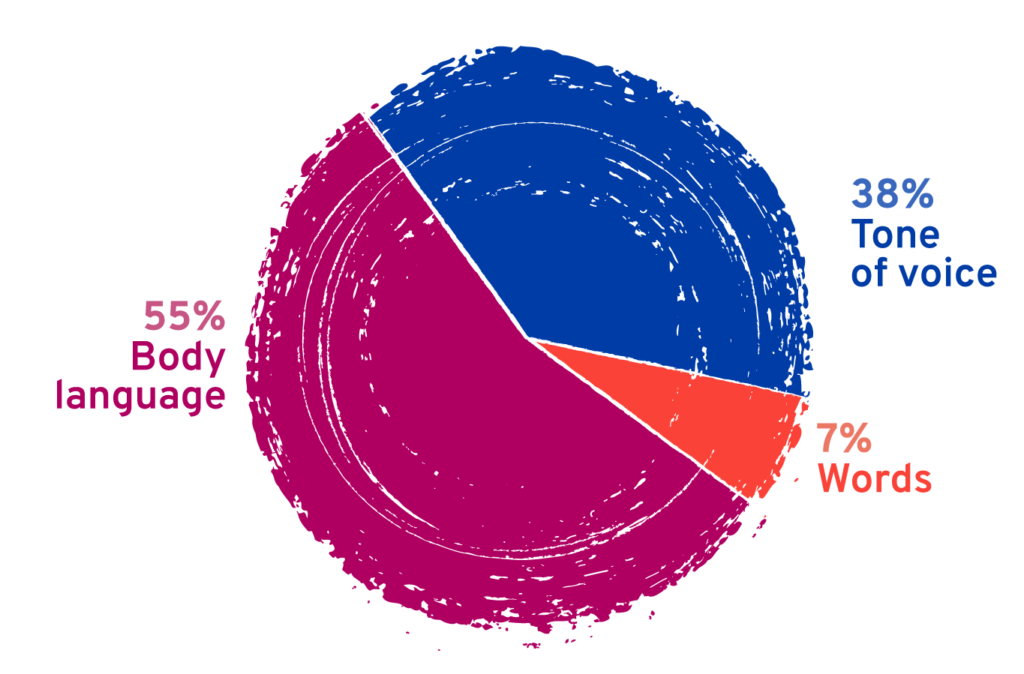
Mehrabian’s Theory of Communication (2)


Communication is about sharing information: thoughts, ideas, stories, and feelings. But this is not limited to what we say with words. Communication includes facial expressions, gestures, body movements, posture, eye contact, and tone of voice.

What great news for all non English native speakers! There are so many ways to express yourself. Even when we struggle with language barriers, this can often result in shared laughter and fun.

Many activities can be planned around effective communication for example:

  • Why not explain an activity in Norwegian or in Thai and then organize translation time afterwards?
  • Have you thought of an activity that requires the creation of a new language?
  • Have you ever compared the animal noises in your language with animal noises in other languages? Fun is guaranteed!
  • The classic game of charades is always a fun way to use your body instead of your words to communicate a thing or idea.

If you come up with a great educational activity on communication, and you think that others could benefit from it, use the Activity Writing Template to write it down and send the completed Template to activities@cisv.org.


Source:

1- Online training module for staff and leaders, register at learn.cisv.org.  Enrolment key: Dialogue2019. If you have any questions, please email learn@cisv.org.

2- Albert Mehrabian’s Theory of Communication

Share
0
Emily Harkness
Emily Harkness

Related posts

Sustainable Development 2020

December 11, 2020

What Older CISVers Think


Read more
Scrabble Tiles Spelling Stay Home
April 17, 2020

Going Green in Quarantine


Read more
Woman holding leaf
April 17, 2020

Understanding CISVers’ Attitudes Towards Sustainability


Read more

Comments are closed.

About Us

  • Home
  • About Us
    • News and blogs
  • Our Programmes
  • Where We Are
  • Diversity, Equity and Inclusion
  • CISV Stories

Copyright 2021 © CISV International
Company registration: 3672838
Registered charity no: 1073308

Get involved

  • Participate in a Programme
  • Volunteer
  • Donate
CISV logo

Resources

  • Educational Activities
  • Communications & Fundraising
  • Blog

Useful Links

  • Sitemap
  • Terms & Conditions
  • Privacy Policy
  • Contact Us
Donate
  • Stories
  • myCISV
  • eLearn